
Who answers your phone at 7 PM? Start by checking your own.
Published 2026-11-18 · Last updated 2026-11-18
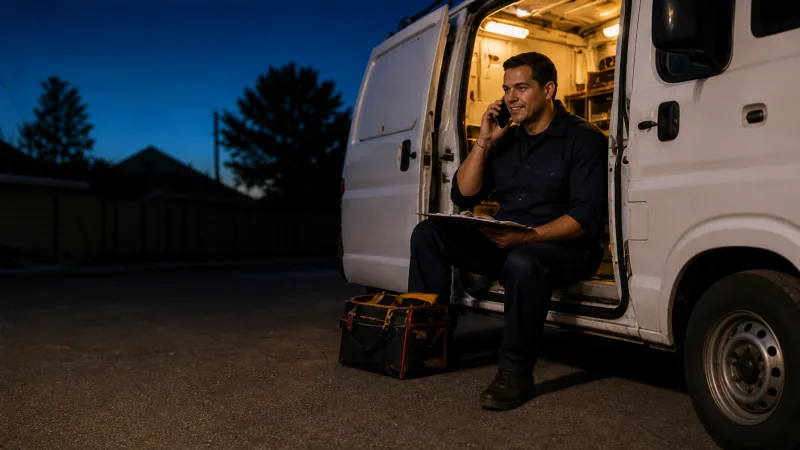
Some data suggests many calls arrive when nobody is there. Here is how to check your own after-hours calls and what your options are.
What time does your phone stop getting answered? Be specific. Not the time on your door, the time you really stop picking up.
And when it rings after that, what happens? Does it go to voicemail? To your cell, while you are at dinner? To nobody?
Now think about the people who call at that hour. A lot of them just got home from work. That is when they finally have time to deal with the leaky faucet, the broken heat, the appointment they have been putting off.
What we know about after-hours calls
There is not much independent data, so here is what exists, with the caveats up front.
One vendor that sells AI receptionists, NextPhone, reports from its own call data that about 28.5% of calls arrive outside standard business hours. That is a vendor looking at its own customers, so treat it as a clue, not a fact about your town (getnextphone.com).
Scorpion's 2026 home services report, covered by Street Fight, found that about two thirds of home service businesses named after-hours customer service as their top challenge (coverage via getnextphone.com). That is a survey of owners, and it tells you the problem is common, not how much it costs.
What these numbers do not tell you
They do not say how many after-hours callers would have booked. They do not say that every business needs to answer at night. Some trades choose not to, and that is a fair choice.
Who calls after hours, and why (our reasoning, not a study)
Think about your own evenings. When do you finally deal with the things you have been putting off? After work, after dinner, on a Saturday morning.
Your customers are the same. Some of them are in a hurry: the heat is out, a pipe is dripping, a tooth hurts. Some are comparing a few businesses while the TV is on. And some just finally have ten minutes.
Those three groups need different things. The urgent ones need to know someone has heard them. The comparers need an answer before they move on. The ten-minute ones need an easy way to say "yes, I want an appointment."
Three ways to cover the gap
There is no single right choice. Here are the common ones, with honest trade-offs:
- Forward calls to a person with a rule. For example, only calls marked urgent ring your cell after 6 PM. It keeps real emergencies reachable, but it needs a way to tell urgent from routine, and it keeps you on call.
- A human answering service. A real person answers and passes on a message. It sounds natural, but it is usually priced per call or per minute, and the person may not know your work well.
- An AI assistant for first contact, a person for follow-up. It answers, asks your questions, and books or takes details. It needs careful setup and a clear path to you for emergencies.
Many businesses mix them: AI for the first answer, a person for anything urgent, and a morning routine to follow up on the rest.
What a good after-hours reply sounds like
Whatever you use, a good reply does three things: it sounds like a person, it is honest about what happens next, and it moves things forward.
"Hi, you have reached Bright Plumbing. We are closed right now, but I can take your details and get you on the schedule for tomorrow. If this is an emergency, such as a burst pipe, please call our emergency line at the number I will give you."
It tells the caller where they are, what you can do, and what to do if it cannot wait. It does not promise something you cannot deliver.
The morning-after routine
Answering is only half of it. The other half is what you do at 8:30 the next morning.
- Open the overnight list.
- Sort by urgency, then by when they arrived.
- Call back the urgent ones first.
- Confirm times with the rest.
- Mark each one done.
If the list sits until noon, you lose some of what you gained overnight.
A 30-day plan
Week 1: log every after-hours call and message, with the time.
Week 2: decide what counts as an emergency for your trade, and write it down.
Week 3: try one of the three options above for a week.
Week 4: compare. Did more after-hours people end up booked? Did you feel less on call?
Questions people ask
Do I have to cover emergencies?
Not necessarily. That is your decision. If you do not, say so clearly in your greeting and tell people what to do, such as calling another service or the emergency line.
What hours should I say I am open?
The honest ones. An accurate "we reply within a few hours" is better than a promise you cannot keep.
What about weekends?
Treat them like evenings. Check your log to see how many calls you really get.
One evening, walked through (made up)
It is 7:15 PM on a Thursday. A homeowner named Dana notices water under her kitchen sink. She searches for a plumber and finds three.
The first goes to voicemail with a long greeting, so she moves on. The second does not answer at all. The third answers right away, asks what is happening, says honestly that nobody can come tonight but offers the first slot tomorrow morning, and tells her how to shut off the water in the meantime.
Dana books the third one. Nothing about the third plumber's work is better than the others. They just answered, were honest, and gave her something to do.
That is the whole point of this post. Nobody needs to be heroic at night. They need to be present, honest and clear.
What this means for you
You do not need a study to know your own pattern. Do this:
- Pull your phone log for the last 30 days.
- Mark every call that came in before 8 AM or after 5 PM, and on weekends.
- Count how many you returned, and how long it took.
If the number is small, relax. If it is not, you have a decision: cover it yourself, share it with someone, or let a service handle first contact and hand you the details in the morning.
One last question. When someone leaves you a voicemail at night, how many of them actually hear back before lunch the next day?
Where we come in
Back Office AI answers after hours, asks the right questions and, on our top plan, books the visit. In a sample call we reviewed, it even said honestly, "I can't promise immediate dispatch, but I can help schedule an appointment." You can hear it on the demo line, (321) 321-8582.
Results depend on your business and how you set it up. No results are guaranteed.
See DataBoost work for your business.
Book a call and we'll walk through your calls, texts, chats, and content.