
The first business to answer usually wins. Here is what the research says.
Published 2026-11-18 · Last updated 2026-11-18
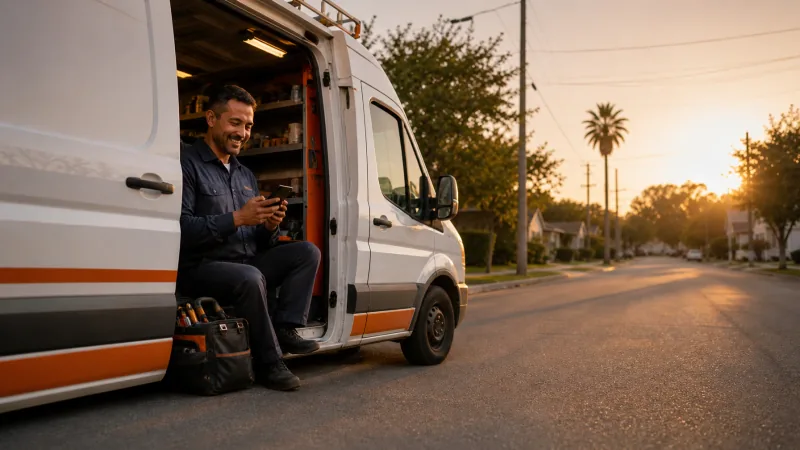
Two well-known studies say the first business to reply usually wins. Here is what they measured, what they did not, and how to check your own reply time.
Picture it. It is 6:42 on a Tuesday evening. You are under a sink, or in a treatment room, or finally sitting down to dinner. Someone fills out the form on your website, or sends a text, or calls.
You see it at 9 the next morning. By then, they have already talked to somebody else.
Nobody did anything wrong. That is just how it goes. Before we get into the research, answer these for yourself:
- When a new inquiry comes in, how long does it usually wait for a first reply?
- Is that the same on a Saturday, or at 8 PM?
- Who is responsible for answering, and what happens when that person is busy?
Write your honest answers down. We will come back to them.
What the studies measured
Two studies get quoted all the time.
The first is a 2007 study by MIT and InsideSales.com. Reports describe it as covering about 15,000 leads at several B2B companies, and it found that the odds of reaching and qualifying a lead dropped quickly as the wait grew. Responding within five minutes did far better than waiting even half an hour.
The second is a Harvard Business Review article from 2011, "The Short Life of Online Sales Leads" by Oldroyd, McElheran and Elkington. It looked at how fast companies contacted online leads. Companies that got back within an hour were far more likely to qualify the lead than companies that waited just one more hour.
We are describing both through summaries, not the original papers, and the summaries disagree on some details such as sample size. So we are keeping exact numbers out of this post until they are checked. The direction is what matters, and it has been consistent for years: faster is better.
Why speed matters (our reasoning, not a study)
Think about what you do when you need a plumber. You rarely contact only one. You send a message to two or three, and you go with someone who answers and sounds like they know what they are doing.
The first reply also sets the tone. It tells the person that someone is paying attention. A reply the next morning tells them the opposite, even if the work you do is excellent.
That is our reasoning, not a statistic. But if you picture yourself as the customer, it probably matches your own behavior.
Be careful with the five-minute rule
You will see "respond in five minutes" everywhere. It is a useful target, but it is also shorthand.
Most of that data came from sales teams working business hours, mostly in B2B. A plumber answering an emergency call at night is a different job. A med spa replying to someone who texted at 8 PM is a different job again. So treat five minutes as a direction to aim for, not a promise that you will win every lead.
A quick example (made up)
Say a small HVAC company gets ten new inquiries in a week. Four come in during working hours, and the owner answers those within the hour. Six come in evenings and weekends. Those get a reply Monday morning.
Nothing is wrong with the work. But the six that waited had a much longer silence, and some of those people have already booked someone else. Nobody will tell the owner that. It just shows up as "slow week."
Your numbers will be different. The point is that the loss is invisible unless you look for it.
Common mistakes
- A fast reply that says nothing. "Thanks, we will get back to you" is faster than silence, but it does not move anything forward. A good first reply asks a question or offers a time.
- An auto-reply nobody reads. If every inquiry gets the same canned text, people notice.
- No owner for inquiries. If it is "whoever sees it first," sometimes nobody sees it.
- Treating calls, texts and web forms differently. Customers do not care which door they used. They care whether someone answered.
- Not measuring. Most owners guess their response time and guess low.
Questions people ask
Do I really need to answer in five minutes, even at night?
No. You do not need to be on call around the clock, and please do not do that to yourself. But you do want a first response that happens quickly and sounds like a person who is paying attention, even if the actual visit is days away.
Is an automatic text enough?
It helps a little. It tells someone you got their message. But it usually does not ask what they need or offer a time, so the customer still has to do the work. We wrote about this in "Missed-call text back is not enough."
Does this apply to my business if I only get a few inquiries a week?
Probably more than you think. When you only get a few, each one matters more.
How to measure your response time properly
Do not trust your memory. Build a tiny log, in a spreadsheet or on paper, with five columns:
- Date and the time the inquiry arrived.
- The channel: call, text, web form, social message.
- The time of the first real reply. A real reply is one from a person, or a message that asks something or offers a time. An automatic "thanks for contacting us" does not count.
- How long that took.
- What happened: booked, not booked, never heard back.
Do this for two weeks. Then sort by waiting time. Almost every owner who tries this finds the same thing: a handful of inquiries answered in minutes, and a long tail that waited many hours. The tail is where you look.
A 30-day plan you can do without buying anything
Week 1: measure. Fill in the log. Do not change anything yet. You are just finding out where you stand.
Week 2: fix the biggest gap. Look at the slowest group. Is it evenings? Weekends? The hours when you are on a job? Pick one and decide who covers it, even if that is you for ten minutes at lunch.
Week 3: write your first reply. Most slow replies are slow because writing a good one takes thought. Write two or three and save them. A good first reply is short, friendly, and moves things forward. For example:
"Hi Sam, thanks for reaching out about your AC. I can come Thursday morning or Friday afternoon. Which works better?"
That one reply gives a name, a service and two times. It is easy to answer, and that is the point.
Week 4: test it. At 8 PM on a weeknight, send yourself an inquiry from a different phone, as if you were a customer. How long until someone answers? What does the reply say? How did it feel?
Repeat the log for another two weeks. If the tail got shorter, you are on the right track.
How to tell whether it worked
Do not judge by one week. Look at three things over a month: the median wait for a first reply, how many inquiries waited longer than a day, and how many turned into bookings. If the first two drop and the third goes up, good. If the third does not move, the problem might be somewhere else: price, availability, or the follow-up after the first reply.
What this means for you
Here is a simple way to find out where you stand, with your own numbers and no software:
- Pull your last 30 days of calls, texts and web forms.
- Write down how long each one waited for a first reply.
- Mark the ones that came in after hours or while you were busy.
- Count how many of those later turned into a booking.
Most owners are surprised by how many messages sat overnight. That pile is where the easy wins are.
Now go back to the three questions at the top. Did your answers hold up against the real numbers?
Where we come in
This is why we built Back Office AI. It answers calls, texts and web chats right away, asks what the person needs and, on our top plan, books the visit. You stay in charge of your schedule, and a person follows up on what needs a human.
You can hear how it sounds on the demo line, (321) 321-8582. Call it, tell it what your business does, and hear how it would answer your customers.
Estimates are not guarantees. Results depend on your business, your area and your follow-up.
Sources
- Oldroyd, McElheran and Elkington, "The Short Life of Online Sales Leads," Harvard Business Review, 2011 (article record: https://scholarsarchive.byu.edu/facpub/9711)
- MIT and InsideSales.com, Lead Response Management study, 2007 (summary on the same page; find and link the original)
See DataBoost work for your business.
Book a call and we'll walk through your calls, texts, chats, and content.