
Can you use AI for your posts without losing your customers' trust?
Published 2026-11-18 · Last updated 2026-11-18
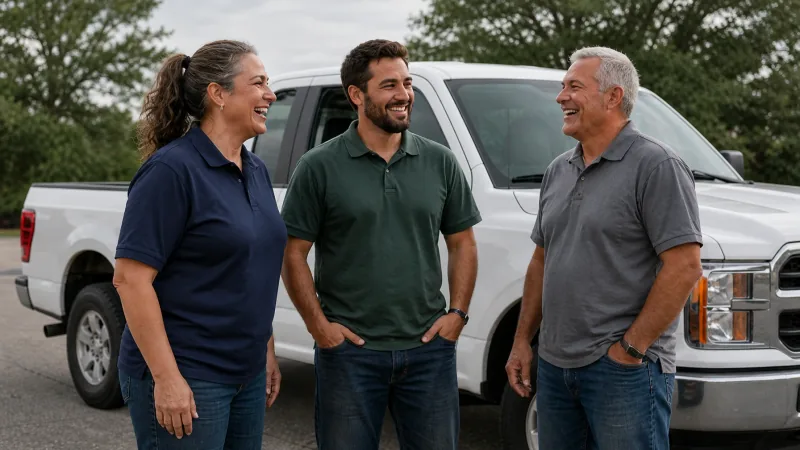
Nearly half of the people in one survey said AI-generated content lowers their trust in a small business. Here is how to use AI and keep it human.
Here is a question to answer honestly before you read on.
If you found out that a local business's posts were written by AI, would you trust them less?
And the other side of it: when you scroll past a post, what makes you stop? Is it the polish, or something that feels real, like a face, a job site or a customer?
What the survey says
A Signs.com survey of 1,000 Americans found that 48% said AI-generated content makes them less likely to trust a small business's social media presence. The same survey found that 31% said user-generated content, such as customer photos and posts, is what they trust most, ahead of brand-created visuals at 27% (signs.com). The survey is self-reported, and Signs.com sells signs, so read it as one data point.
We are a company that uses AI to make posts, and we are telling you this on our own blog. It is a real number, and it matters.
What it does not say
It does not say AI is off limits. It says people are wary when content feels artificial or when they suspect a business hid the fact. It is one survey, from a company that sells signs, so it may lean toward real, physical things.
How we think about it
The problem is not the tool. It is what comes out of it: generic, shiny posts that could belong to any business anywhere.
So we aim for the opposite:
- Real photos wherever you have them. Your jobs, your team, your shop. We use them first.
- Your voice. The posts should sound like you talking to a neighbor.
- You approve everything. Nothing goes out until you say yes.
- Honest labels. On this site, the people in our sample images are marked as AI-generated examples. We would ask the same of anyone.
Where AI helps, and where it should stay out of the way
AI is good at the parts of content that are tiring:
- Turning a few notes into a first draft.
- Suggesting topics when you are stuck.
- Making many versions of the same idea.
- Keeping a schedule going.
It is weak at the parts that make a business feel real:
- Your actual jobs and your actual customers.
- Local details only you would know.
- The honest "we got this wrong, and here is how we fixed it."
- Your sense of humor.
A good rule: let AI draft, and let a person make it true.
Generic versus real (made-up examples)
Compare these two lines for an imaginary plumber.
Generic: "We deliver exceptional service and quality workmanship for all your plumbing needs."
Real: "Last Tuesday we replaced a water heater in a house on Maple Street in about two hours. The owner had been without hot water for three days."
The first could belong to anyone. The second could only belong to one business. It does not need to be fancy. It just needs to be specific.
A trust checklist for each post
Before you approve a post, ask:
- Does it mention something that really happened?
- Is the photo ours, or at least accurate?
- Would a customer recognize us in it?
- Does it sound like us?
- Is there anything in it that we cannot back up?
If you cannot say yes to most of these, send it back.
Should you say you use AI?
That is a judgment call, and we would say it this way: do not hide it, and do not make a big deal of it. If someone asks, tell the truth. Some platforms also require labels on certain kinds of AI-generated images, and the rules change, so check the current ones.
The bigger point is the one in the survey: people trust what feels real. Honest, specific, human content earns that trust, however you make it.
A 30-day plan
- Week 1: collect real material. Photos of jobs, a few customer messages, a list of questions you get asked.
- Week 2: draft posts using that material, with AI or without.
- Week 3: approve only the ones that pass the checklist, and add your own photo to each.
- Week 4: look at which got replies or messages, and do more of those.
Questions people ask
Is AI content bad for my page?
Not by itself. Generic content is. The survey suggests people are wary when it feels artificial.
Can I use stock photos?
Sometimes, but real photos usually work better, and you need the right to use them.
Should I tell customers?
Be honest if they ask. Mark sample images as examples, as we do on this site.
Real photos you already have
Most owners have more usable photos than they think. Look in:
- Your phone, from the last few jobs.
- Your team's phones.
- Customer messages, where they sent you a picture of the problem.
- Reviews with photos, which you can ask to share.
- Your truck, your shop, your tools, your front door.
A few tips that cost nothing:
- Clean the lens first.
- Use daylight when you can.
- Take a photo before and after every job.
- Keep faces and house numbers private unless you have permission.
- Ask customers before you post anything that shows them or their home.
One real, slightly imperfect photo usually does more than a polished image that could belong to anyone.
What this means for you
Look at your last five posts. Which ones would you proudly show a customer? Which ones could have come from anyone?
The ones that feel real are the ones to repeat. If you cannot tell the difference, ask a customer.
Where we come in
On our content plans, Marketing & Sales AI does the heavy lifting of planning and drafting, and you keep the human parts: your photos, your say and your name on it.
Results depend on your business, your market and your content. No results are guaranteed.
See DataBoost work for your business.
Book a call and we'll walk through your calls, texts, chats, and content.